
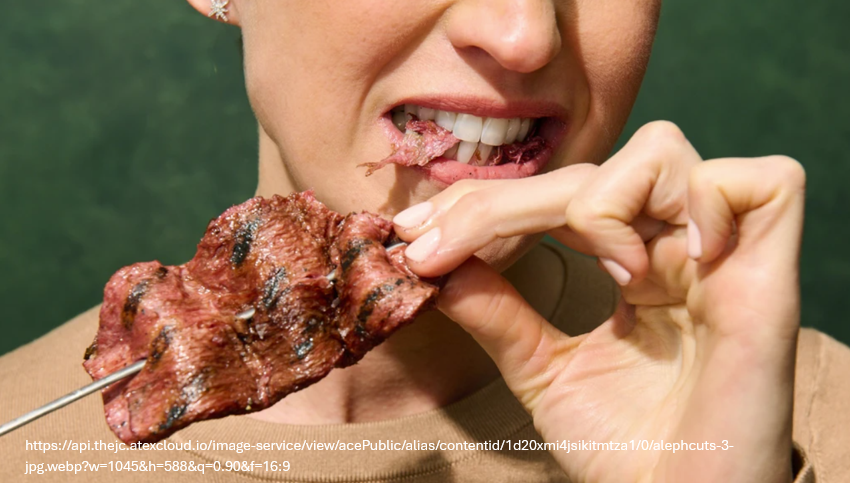
As the Israeli biotech start-up in Rehovot seeks regulatory approval abroad, its team assures that it will work in tandem with farmers, not against them.
Article By: Eliana Jordan, The Jewish Chronicle
If it tastes like beef, looks like beef, but doesn’t moo like beef – is it still a steak?
In light of the arms race to create the perfect meat replacement, that’s the question that dozens of companies are trying to answer – with various methods.
Aleph Farms is an Israeli company trying to create steak by cloning meat taken from one cow named Lucy.
“You can’t compare this with an entrecote or a tenderloin – this is a completely different type of meat. We are creating a new category,” said Galia Reicher, co-director of corporate development at food tech start-up Aleph Farms.
I visited the Rehovot headquarters of Israel’s leading cultivated meat company with Technion –Israel Institute of Technology to learn about the production of its stem-cell-derived steak against the backdrop of a mounting effort to see cultivated meat banned across the globe.
Why? That’s the question I sought to answer when I entered the sleek, 65,000 square foot facility of the company that counts Leonardo DiCaprio among its investors.
In January, Israel became one of the first countries to approve the sale of lab-grown meat, and Aleph Farms, founded by the Strauss Group and Technion biomedical researcher Shulamit Levenberg in 2017, is the first company in the world to receive regulatory approval for its unique whole cut steak soon to hit the domestic market.
Reicher showed me the product, frozen and vacuum-sealed in plastic. It’s thinner than any cut of beef I’ve seen, but otherwise resembles the real thing – provided you don’t look too closely.
The ersatz steak is derived from a Black Angus cow called Lucy, who provided the stem cells from which thousands of tons of cultivated meat can be produced in Aleph Farms’ laboratory. Using a proprietary technology based on 3D bio-printing, the cells, harvested from Lucy’s fertilized eggs, are incubated in a culture, a sort of nutrient soup, where they grow for four weeks in a manner that mimics natural cell growth in the cow’s body. The cells are then mixed with a ‘scaffold’ of plant-based ingredients to give the steak its meaty structure.
The final product is as close to the real deal as any meat substitute has ever come, even reflecting the nutritional and calorific values of its archetype. But its divergences from real meat are arguably its strongest features; as Reicher explained, one of the major advantages to cultivated meat is the consistency of the finished product.
“If you go to a restaurant today and order a steak, sometimes it’s a bit dry, sometimes it has too much fat. Here you have a consistent quality – every batch is the same because it’s produced the same way.”
It’s also “idiot-proof” to cook. Although it only needs one minute over heat, “even if you leave it for an hour, it will not dry,” said Reicher. “It stays always juicy, and that’s because of the way the steak is structured. So, we can really tailor it to the needs of our customers.”
But Florida and Alabama recently banned the sale of cultivated meat, and Texas, Arizona and Tennessee appear soon to follow. In April, before Florida Governor Ron DeSantis signed the bill into law, he called the push for the sale of cultivated meat part of an “ideological agenda” targeting traditional agriculture and warned cellular agriculture companies to “take your fake lab-grown meat elsewhere.” Shortly after, Alabama Governor Kay Ivey signed a bill that makes selling lab-grown meat a misdemeanor.
The rhetoric used by DeSantis has amplified the nascent fear that cultivated meat products will compete with farmers and cattle ranchers, implying that the advent of the former will necessitate the downfall of the latter.
And yet, some of the industry’s key players – including major meatpacking corporations Cargill and Tyson – have invested millions of dollars into cultivated meat companies, including Aleph Farms.
“I think they’re looking at the same consumer surveys as we are and seeing that the next generation of consumers are not going to be only eating conventional meat, and therefore they have to supply the consumers with what they want,” said Gary Brenner, another co-director of corporate development at Aleph Farms.
Polling in July found that one in four Britons are open to trying cultivated meat and, with the UK recently becoming the first country in Europe to approve the sale of lab-grown meat (albeit for a pet food company), it appears they might soon have the chance.
Brenner explained that meat industry experts around the world are aware that the current demand for meat, ever rising in tandem with population growth, cannot be sustainably met by the supply.
Where industrial cattle farming requires between 15 and 30 months to process the cow from farm to table, an Aleph Farms steak takes just four weeks to cultivate. In terms of its environmental impact, the production of cultivated meat accounts for a 92 per cent reduction in greenhouse gas emissions when compared to western European beef production, an industry notorious for its high environmental toll. Pair with that a 66 per cent reduction in water use and 90 per cent reduction in land use, and cultivated meat can offer an exponentially more sustainable alternative.
Click here to continue reading the full article in the Jewish Chronicle