

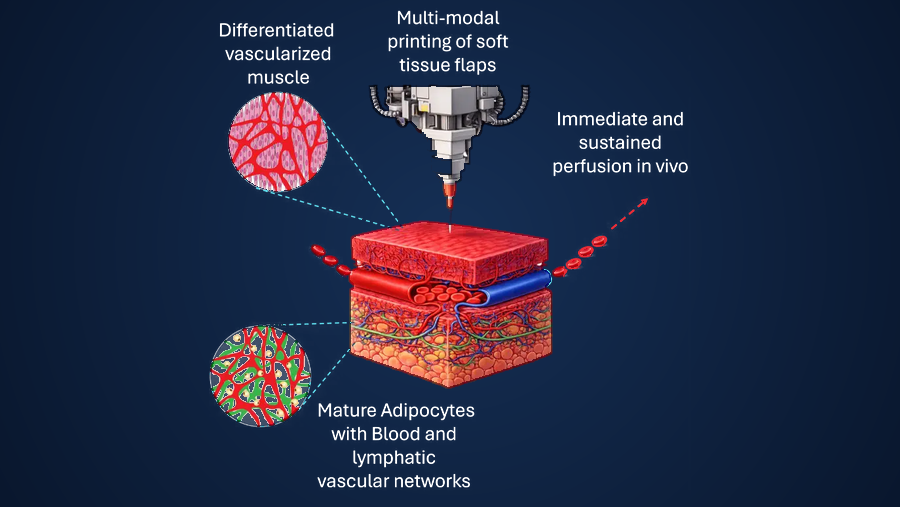
With muscle, fat, blood vessels and a lymphatic network in one structure, the new flap could one day give surgeons an alternative to harvesting tissue from a patient’s own body.
Patients who lose large amounts of tissue to injuries, burns or tumour removal may one day receive a 3D-printed implant built to match what’s missing. An international team led by Prof. Shulamit Levenberg’s lab in the Technion’s Faculty of Biomedical Engineering has created a first-of-its-kind flap that combines muscle and fat tissue with networks of blood vessels and lymphatic vessels, and published the results in Cell Biomaterials.
Today, surgeons treat major tissue loss by taking a flap from a healthy part of the patient’s own body, since tissue from another person is usually rejected by the immune system. Any implant needs blood vessels to deliver oxygen and nutrients and to clear away waste. The new flap is the first to include a lymphatic network, the system that drains excess fluid from tissue, along with a loop of artery and vein that connects directly to the blood supply at the implant site.
By fine-tuning the printing process, the team produced a construct that closely mimics the missing natural tissue. In the future, the technology could allow surgeons to use personalized flaps tailored to each patient’s injury.
 Meet the researcher: Prof. Shulamit Levenberg