Published By: Ofer Asaf, ed. Christina Vergopoulou, Designbloom.com
Date Published: October 7, 2026
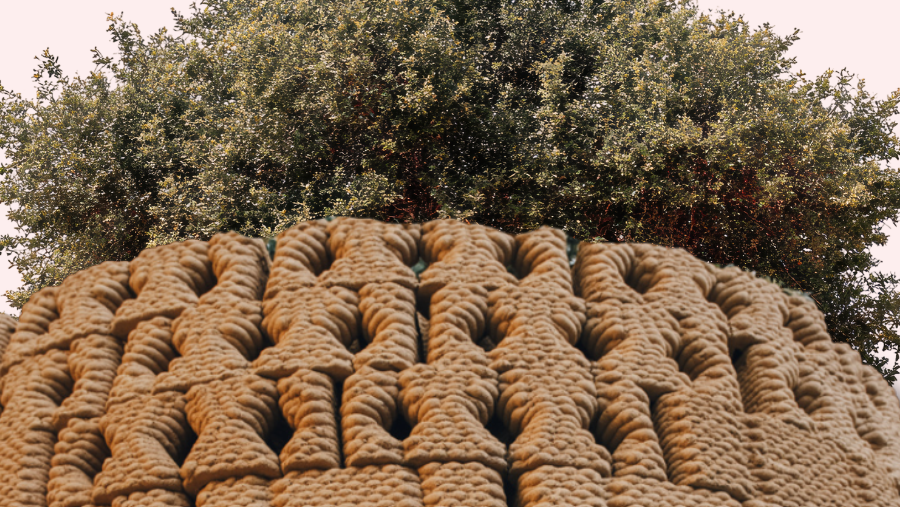
Robotically 3D printed earth bricks wrap multispecies habitat around olive tree
The pavilion combines computational fabrication with dryland agricultural knowledge to create a porous structure that regulates shade, heat, airflow, and moisture while providing niches for plants, insects, birds, fungi, and other species.
BUSTAN, meaning ‘orchard,’ is a full-scale earthen pavilion developed by the Material Topology Research Lab (MTRL) at the Technion – Israel Institute of Technology and Weizmann Tree Lab for The Circle exhibition at Design Museum Holon. Built from 178 robotically 3D printed earth bricks, the structure is organized around a living olive tree, treated as the pavilion’s primary client. The bricks are made mainly from locally sourced soil mixed with bio-based plant fibers and mineral binders. Each brick is digitally designed and robotically printed with a specific geometry and surface texture, giving it an ecological function related to shade, thermal mass, airflow, moisture, or habitat.
Click here to continue reading the full article in Designbloom