Featured Image

First 3D-Printed Tissue Flap With a Lymphatic Network Could Help Injury and Burn Patients

With muscle, fat, blood vessels and a lymphatic network in one structure, the new flap could one day give surgeons an alternative to harvesting tissue from a patient’s own body.

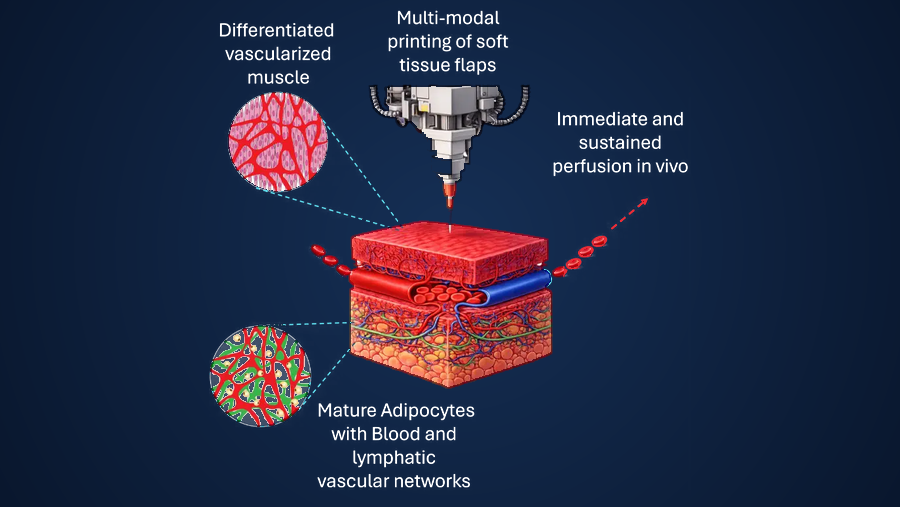
Patients who lose large amounts of tissue to injuries, burns or tumour removal may one day receive a 3D-printed implant built to match what’s missing. An international team led by Prof. Shulamit Levenberg’s lab in the Technion’s Faculty of Biomedical Engineering has created a first-of-its-kind flap that combines muscle and fat tissue with networks of blood vessels and lymphatic vessels, and published the results in Cell Biomaterials.

Today, surgeons treat major tissue loss by taking a flap from a healthy part of the patient’s own body, since tissue from another person is usually rejected by the immune system. Any implant needs blood vessels to deliver oxygen and nutrients and to clear away waste. The new flap is the first to include a lymphatic network, the system that drains excess fluid from tissue, along with a loop of artery and vein that connects directly to the blood supply at the implant site.

By fine-tuning the printing process, the team produced a construct that closely mimics the missing natural tissue. In the future, the technology could allow surgeons to use personalized flaps tailored to each patient’s injury.

Meet the researcher: Prof. Shulamit Levenberg

Prof. Shulamit Levenberg is a professor in the Technion’s Faculty of Biomedical Engineering and directs the Technion’s 3D Bioprinting Center. She was the first to engineer tissue flaps with their own blood vessels, opening up new ways to reconstruct damaged tissue, the line of work behind this new implant. She served as Dean of the faculty from 2017 to 2020.

She earned a B.Sc. in biology from the Hebrew University of Jerusalem and a Ph.D. in molecular cell biology from the Weizmann Institute, then did postdoctoral research in tissue engineering with Prof. Robert Langer at MIT. She joined the Technion in 2004.

Her honours include the Krill and Rappaport prizes and a Medal of Distinction from the Peres Center for Peace and Innovation, and she is a fellow of the National Academy of Inventors. She has also co-founded three start-ups, working on cultured meat, spinal cord regeneration and rapid testing of which antibiotics work against an infection.

Support Israel’s Brightest Medical Innovators

How do you build a healthier world for future generations? It’s built with groundbreaking technology.

As Israel’s top technological university, and one of only a handful in the world with a medical school, the Technion is uniquely positioned to transform the future of patientcare by developing cutting-edge medical innovations.

This Giving Tuesday, an anonymous donor will match your gift to support Israel’s brightest medical innovators. Double your impact today and help the Technion repair the world for future generations.