
Technion researchers have developed a wearable sensor that uses light and sound to track blood pressure continuously, without an inflatable cuff
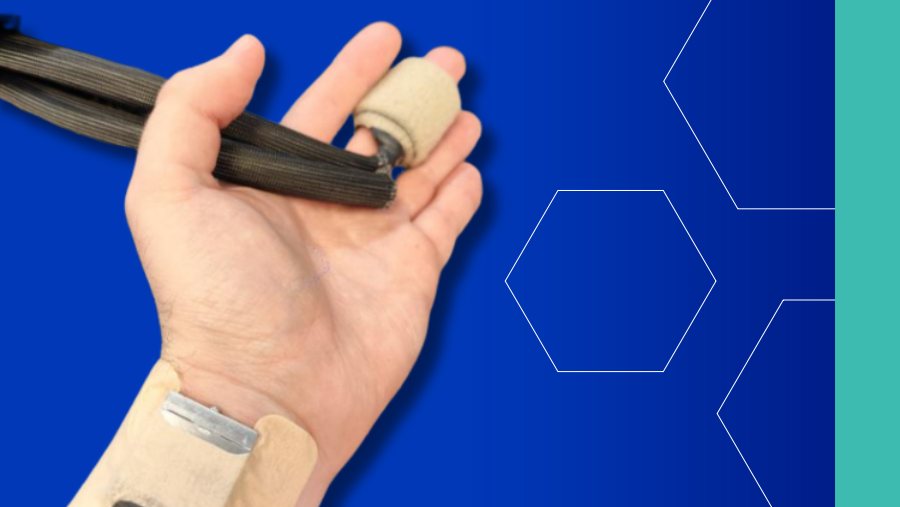
A tiny wearable sensor developed at the Technion could one day measure blood pressure continuously, with no inflatable cuff and nothing for the wearer to do. Prof. Amir Rosenthal and Prof. Daniel Lange of the Andrew and Erna Viterbi Faculty of Electrical and Computer Engineering built the device with doctoral student Gil Gelbert.
The sensor, called SPADE, sends short pulses of light into an artery, where they create ultrasound waves. It then measures the artery’s exact width and how it changes with every heartbeat, and AI modelling turns that data into a real-time blood pressure reading. It needs just one sensing component and keeps working even when its position shifts. In early tests with volunteers, it captured 100 measurements per second.
The team sees the technology one day built into smartwatches and medical patches, giving people living with cardiovascular disease a continuous picture of their heart health at home, at work and on the go.
Meet the researcher: Prof. Amir Rosenthal

Prof. Amir Rosenthal leads the Laboratory for Biomedical Imaging and Sensing (LBIS) at the Technion’s Andrew and Erna Viterbi Faculty of Electrical and Computer Engineering.
His lab develops new medical technologies that use light, sound and combinations of the two, including optoacoustic imaging systems and ultra-sensitive ultrasound detectors.
A Technion graduate, he earned his B.Sc. in 2002 and his Ph.D. in 2006, both in electrical engineering. He then spent 2009 to 2010 as a Marie Curie Fellow at the Cardiovascular Research Center of Massachusetts General Hospital and Harvard Medical School. From 2010 to 2014, he led a research group at the Institute for Biological and Medical Imaging at Helmholtz Zentrum München and the Technical University of Munich.
He returned to the Technion as a faculty member in 2015. His research focuses on hybrid imaging technologies that see deep inside the body, as well as minimally invasive imaging procedures.